Kate Hemady, PhD
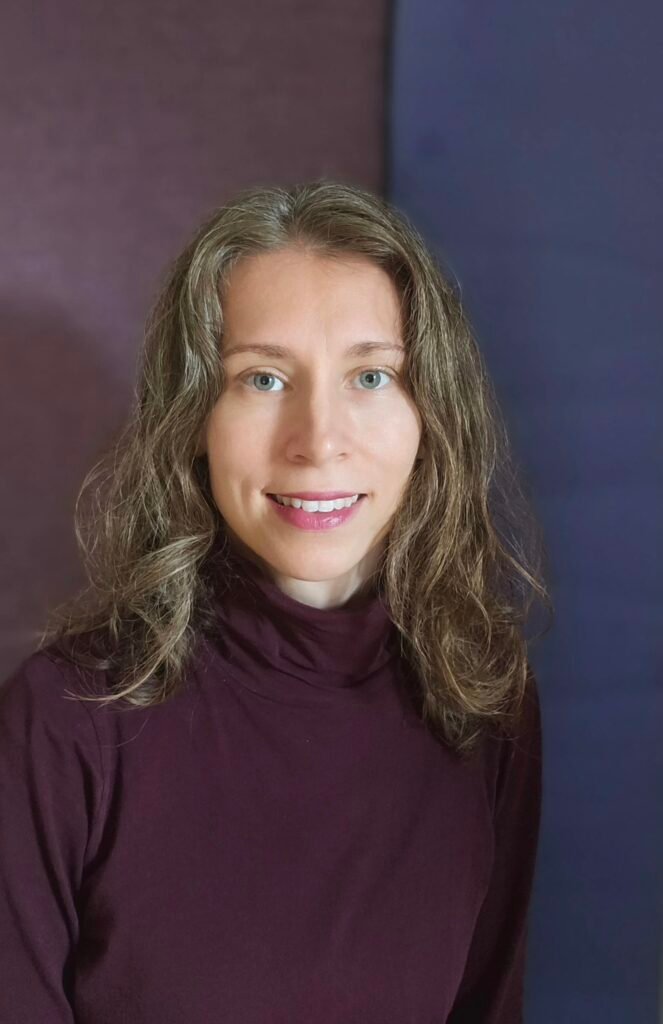
Kate earned an M.S. and a Ph.D. in Human Development and Family Studies from the Pennsylvania State University, studying with preeminent scholars in prevention science, advanced statistics, positive youth development, and family systems. During her education, she built interdisciplinary expertise in parenting, and the interactions, development, and contexts of children and their families.
Kate now has nearly a decade of experience in evaluating community-implemented family strengthening- and child well-being-focused programs. While based at Public Health Management Corporation, in Philadelphia, she served as lead evaluator or PI for multiple federally funded projects, including 1) program evaluations ranging from a randomized controlled trial and rigorous quasi-experimental evaluation to responsive process evaluation and quality improvement, and 2) coalition support rooted in developmental evaluation. In these and foundation-funded projects, she partnered with dozens of program teams to develop new service approaches, provide implementation support, and evaluate outcomes. Driven by community partnership, these joint evaluation projects focused on enabling innovative and needed services that were identified by service agencies and often included cross-sector partnerships.
In that work, Kate came to realize that evaluation did not describe where she made the most impact, even in the evaluation role. The heart of her work was program design, technical assistance, capacity-building, and change management. She founded KH Human Services Consulting from the belief that those services should be available to nonprofits EVEN IF there is no plan for evaluation, and EVEN IF there is no grant funding for a special project.
Now, as a consultant, she takes on the combined and varied role of an implementation support practitioner. Alongside this role she simultaneously holds the role of subject matter expert, which is a unique and valuable asset in supporting an organization’s effectiveness. Her goal is not to test an organization’s performance or to make an organization conform its programming to academic standards, which are often narrowly considered. Her mission is to empower community-based organizations (CBOs) to meet their community’s needs with proven best practices for greater effectiveness and sustainability. That can mean, among other examples,
- a light touch like collecting input and recommending training to shift staff approach or mindset, or
- a short-term contribution like structuring community engagement to allow for meaningful contribution in service planning, or providing an external perspective to a coalition, or
- a multi-year process of deeply integrating an evidence-based program (EBP) into an organization’s service offerings or, when needed,
- tailoring an EBP into the specific contexts of CBOs and agencies or for a new audience.
Kate thinks flexibly and broadly to ensure what an organization offers to their clients is what’s needed in the community. She considers organizational and external factors like staff skills and values, organizational mission, funder and system requirements, referrals, cross-sector communication and the like. She provides both technical and human-level support, temporarily scaling up an organization’s capacity while building long-term internal capacity.
The consultation she now provides is rooted in deep theoretical knowledge relating to program theory of change, additional training in systems change approaches, and accumulated experience of CBO workflow, staffing, and contexts, including child welfare systems, substance use treatment agencies and systems, and health and mental health systems. Kate seeks to improve outcomes for children and their family members for generational impact that promotes equity.
Kate’s advocacy and strategic planning work aims to reimagine human service systems that lift up families with holistic support. She calls Maryland home and has deep generational ties to Baltimore. Not far away, Pennsylvania has a special place in her heart, as the place her career started and where her children were born.